
Blackish Blind Snake
Anilios nigrescens
Often mistaken for an earthworm — this tiny fossorial snake lives entirely underground, feeding on ant and termite eggs. Harmless, protected, and one of Sydney's most common garden reptiles.
0428 458 856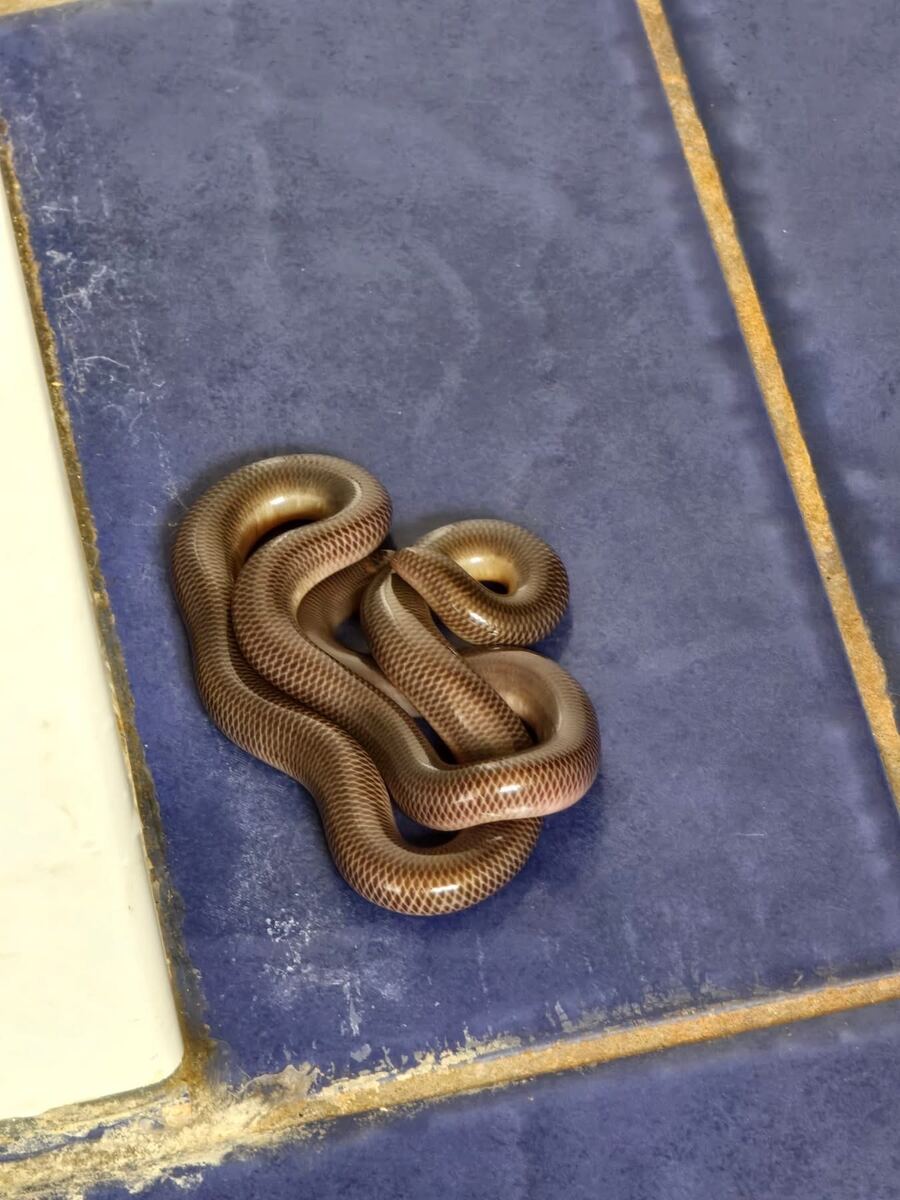
Scientific Name
Anilios nigrescens
Average Length
20 – 50 cm
Danger to Humans
Non-Venomous
Activity
Fossorial (Underground)
Identification
- Colour: Dark brown to purplish-black on the back. Belly is similar in colour or slightly paler. The scales are tiny, smooth, and uniform.
- Size: Very small — adults typically 20 to 50 cm. One of the smaller snake species in NSW.
- Build: Cylindrical, worm-like body with no visible neck distinction. Head and tail are nearly the same size — making it difficult to tell which end is which at a glance.
- Eyes: Tiny, vestigial eyes covered by scales — they cannot form images but can detect light. This gives the species its 'blind snake' common name.
- Tail: A small sharp spine at the tail tip — used to anchor itself while burrowing.
Commonly mistaken for a large earthworm — look for shiny, uniform scales (earthworms have segmented, dull skin) and a slightly pointed tail spine to confirm it's a blind snake.
Habitat & Distribution in NSW
- Found underground in loose, moist soil
- Under rocks, logs, leaf litter, and garden mulch
- Suburban gardens — one of the most common garden snakes in Sydney
- Woodland, heath, and forest
- Often unearthed during gardening, digging, or after rain
Found throughout coastal and inland NSW. Very commonly encountered in Sydney suburbs during garden work or after heavy rain brings them to the surface.
Behaviour & Diet
Behaviour
- Spends nearly all its life underground (fossorial)
- Surfaces after heavy rain or accidentally during digging
- Completely non-aggressive — cannot bite effectively
- Egg-laying species
- Moves in a smooth, worm-like manner
Diet
- Ant eggs, larvae, and pupae
- Termite eggs and larvae
- Follows ant trails underground to find food
Is a Blind Snake Dangerous?
Absolutely not. The Blackish Blind Snake is completely harmless to humans. It has no venom, no functional teeth capable of breaking skin, and no defensive bite. If you find one in your garden, simply leave it alone — it is doing no harm and is entirely beneficial. It is protected by law and should not be killed or harmed.