
Diamond Python
Morelia spilota spilota
Australia's most southerly python — stunning, non-venomous, and fully protected. Requires licensed relocation if found on your property.
0428 458 856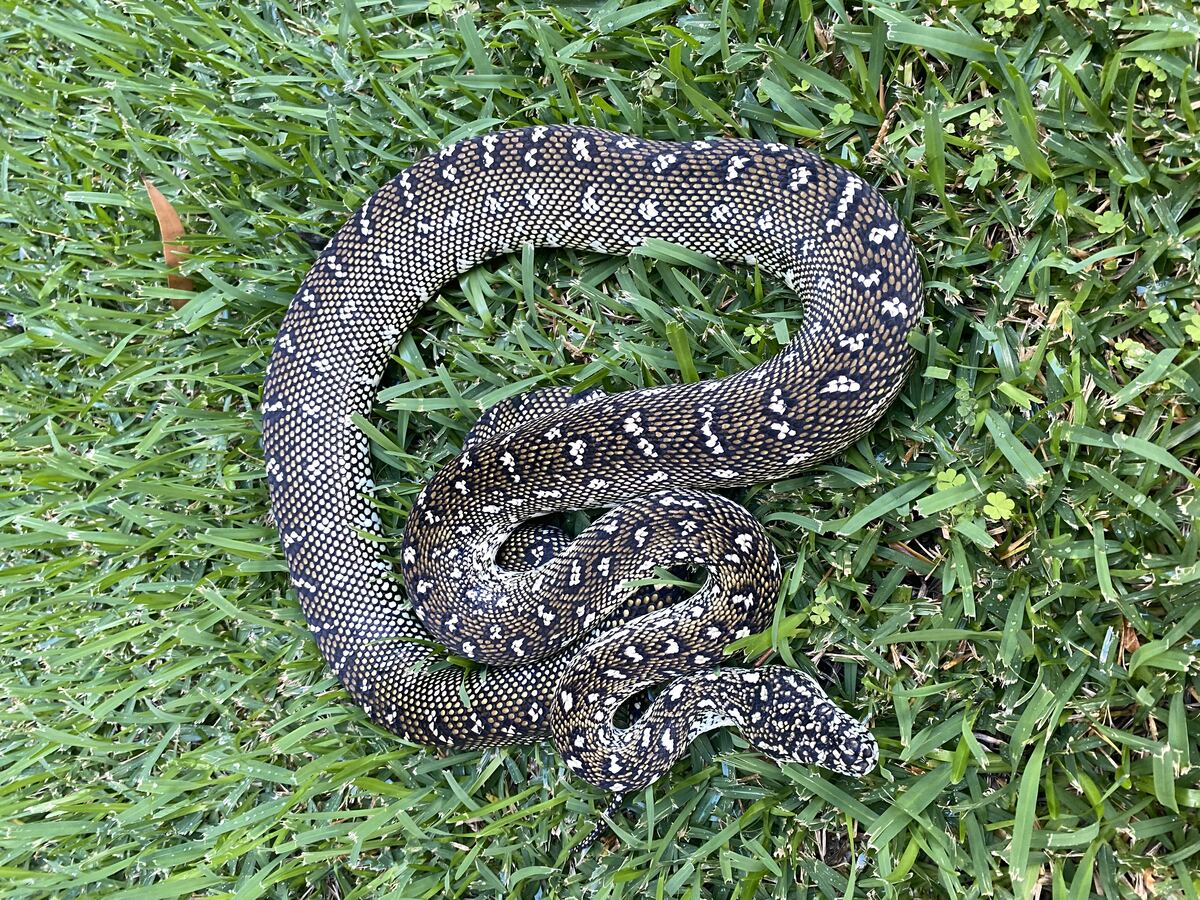
Scientific Name
Morelia spilota spilota
Average Length
1.5 – 2.5 metres
Danger to Humans
Non-Venomous
Activity
Nocturnal & Crepuscular
Identification
- Colour: Glossy black back with irregular clusters of cream, white, or yellow scales forming a striking diamond or rosette pattern — unmistakeable.
- Size: Adults typically 1.5 to 2.5 metres. Large individuals may reach 3 metres or more.
- Build: Heavy-bodied and muscular with a broad, triangular head clearly distinct from the neck. Heat-sensing pits along the lip scales.
- Eyes: Vertical, cat-like pupils. Large, prominent eyes.
- Young: Juvenile Diamond Pythons are similarly patterned but more yellowish-green — can be confused with Green Tree Pythons (not found in NSW).
The Diamond Python is one of the most recognisable and beautiful snakes in Australia. If you find one in your garden, it's doing you a favour by keeping rodent numbers down.
Habitat & Distribution in NSW
The Diamond Python is found throughout coastal and near-coastal NSW and is particularly common in Greater Sydney:
- Suburban gardens and bushland margins
- Sydney's coastal heathland and escarpment areas
- Rainforest edges and moist woodland
- Rocky outcrops and cliff faces
- Commonly found in roof spaces, under decks, and in tree hollows
Regularly reported across the Sutherland Shire, Northern Beaches, Blue Mountains, Illawarra, Central Coast, and Hunter Valley.
Behaviour & Diet
Behaviour
- Ambush predator — waits in trees or on the ground for prey
- Nocturnal and crepuscular — most active at night
- Constrictor — kills prey by squeezing
- Generally docile but may bite defensively if threatened
- Egg-laying (oviparous) — clutches of 10–50 eggs
- Female coils around eggs to incubate them — a remarkable behaviour
Diet
- Possums (major food source)
- Rats and mice
- Rabbits
- Birds
- Large lizards
Is a Diamond Python Dangerous?
Diamond Pythons are non-venomous and pose no serious danger to humans. They kill prey by constriction, not venom. However:
- Large pythons can deliver a painful bite if threatened — their teeth are recurved and can cause lacerations
- They are strong constrictors — do not handle large individuals
- Bites are not medically dangerous but should be cleaned and monitored for infection
- They are fully protected — handling or relocating without a licence is illegal