
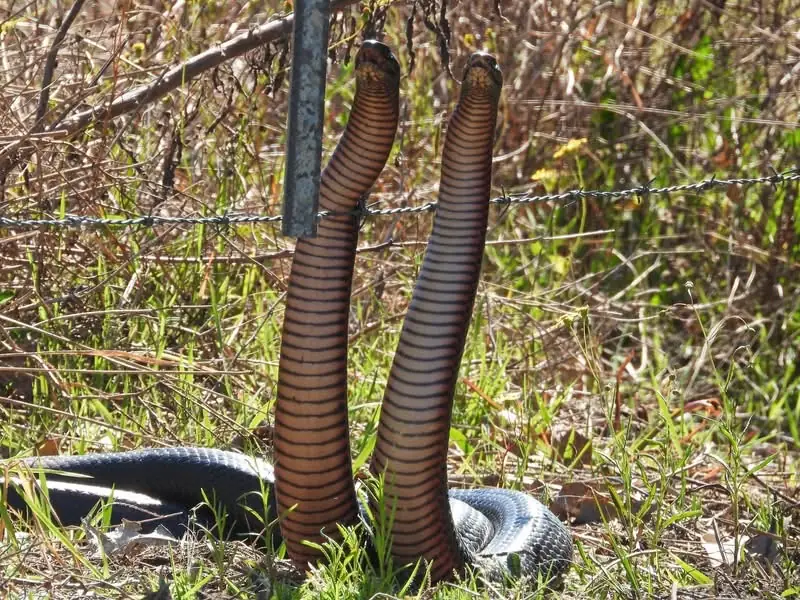
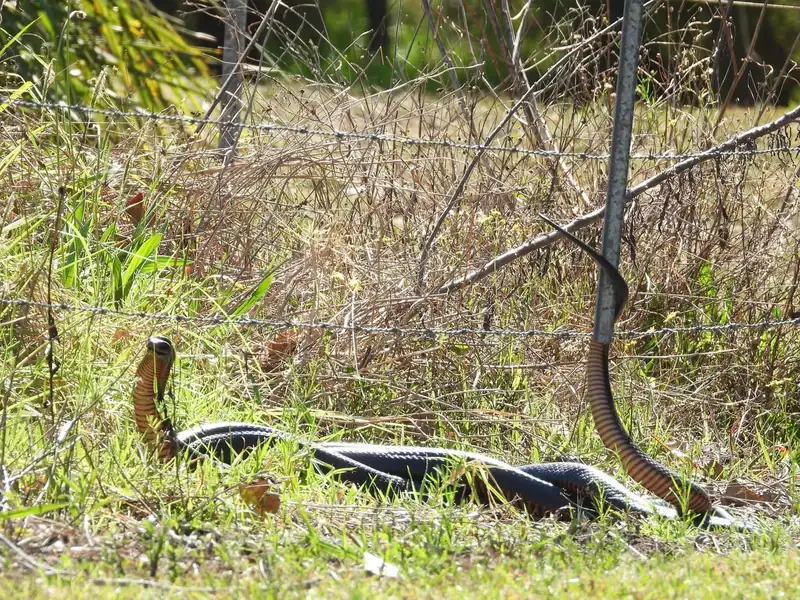
As the weather warms up across the Sutherland Shire, snake activity increases. Along with more sightings in backyards, gardens and around bushland, residents may occasionally witness something extraordinary: two snakes intertwined, raising their bodies off the ground and wrestling with one another.
It is easy to assume you are watching two snakes mating. However, in many cases, you are actually witnessing male snake combat. This fascinating behaviour is part of the natural breeding cycle of several Australian snake species, including the Red-bellied Black Snake and Eastern Brown Snake.
What is male snake combat?
Male snake combat occurs when two males compete for access to a female during the breeding season. Rather than a typical defensive encounter, the snakes engage in a physical contest of strength. You may see:
- Both snakes raising the front sections of their bodies.
- Their necks hooking around one another.
- Their bodies twisting and becoming intertwined.
- Each snake attempting to push the other's head towards the ground.
- One snake eventually retreating after losing the contest.
These encounters can look intimidating, particularly when the snakes are large. Despite appearances, this is natural reproductive behaviour rather than an attempt to hunt or feed on one another.
Red-bellied Black Snake combat around the Sutherland Shire
Red-bellied Black Snakes are regularly encountered in the Sutherland Shire, particularly around waterways, wetlands, creeks and bushland. Residents in the following suburbs may encounter snakes where properties border suitable habitat:
- Engadine
- Heathcote
- Woronora
- Loftus
- Yarrawarrah
- Woronora Heights
- Bonnet Bay
- Gymea Bay
- Sutherland
- Kirrawee
- Jannali
During spring, male Red-bellied Black Snakes actively search for females. When two males encounter one another, they may spread their necks, raise their forebodies and intertwine in a slow wrestling contest.
One interesting fact is that Red-bellied Black Snakes give birth to live young rather than laying eggs. Their breeding behaviour is fascinating, but these are venomous snakes and should never be approached.
Eastern Brown Snakes also engage in combat
Eastern Brown Snakes are also found in parts of the Sutherland Shire. They are highly venomous and can occur around open bushland, grassed areas, bushland boundaries and residential properties.
Male Eastern Brown Snakes engage in ritual combat during their breeding season. Two males may intertwine tightly and wrestle for an extended period, with each attempting to overpower the other by pushing its opponent's head down. The objective is to establish dominance and gain access to a receptive female, rather than necessarily killing the opponent.
How can you tell the difference between mating and combat?
Male combat
- Typically involves two males.
- Both raise the front sections of their bodies.
- Necks and bodies intertwine.
- They actively push and wrestle against one another.
- The contest can involve considerable movement.
Mating
- Typically involves a male and a female.
- The male follows and courts the female.
- Their bodies align alongside one another.
- Their tails come together during copulation.
- They may remain connected for several hours.
These are general clues, not a reason to approach or try to identify the snakes yourself. Keep a safe distance regardless of what they appear to be doing.
Why does this happen around the Sutherland Shire?
The Sutherland Shire has extensive bushland, waterways and protected habitat. Royal National Park, Heathcote National Park and the Georges River provide suitable habitat close to residential areas. Many properties back onto creek lines, drainage reserves and green corridors.
During spring, increasing temperatures encourage snakes to become more active and search for food and potential mates. Residents may notice snakes moving through gardens, crossing driveways and pathways, travelling along waterways and bushland boundaries, or occasionally engaging in combat.
Seeing two snakes together does not automatically mean they are mating or fighting. They may simply be sharing suitable habitat or shelter.
What should you do if you find two snakes wrestling?
Leave them alone. Even if they appear distracted, they are wild animals capable of defending themselves if disturbed.
- Keep children and pets well away.
- Maintain a safe distance from both snakes.
- Do not attempt to move, touch or separate them.
- Only take a photograph or video if you can do so safely from a distance.
- Contact a licensed snake catcher if people or pets could come into contact with them.
If the snakes are in a safe location, allowing them to move on naturally is often the best outcome.
Local snake removal throughout the Sutherland Shire
At Shire Snake Wranglers, we assist residents with snake sightings, identification, removal and advice throughout the Sutherland Shire. Whether it is a Red-bellied Black Snake near a pool, an Eastern Brown Snake in the garden or two snakes engaged in breeding-season combat, knowing how to respond is important.
Snakes are an important part of our local ecosystem. Understanding their behaviour helps us coexist with them while keeping our families and pets safe.
Frequently asked questions
Are two snakes wrestling or mating?
Raised forebodies, intertwined necks and repeated attempts to push each other down can indicate male combat. During mating, the bodies tend to align and the tails come together. These are clues, not a reliable way to identify behaviour from close range; always keep your distance.
Do Red-bellied Black Snakes lay eggs?
No. Red-bellied Black Snakes give birth to live young, unlike Eastern Brown Snakes, which lay eggs.
Should I separate two snakes in my garden?
No. Keep children and pets away and do not touch, move or separate the snakes. Contact a licensed snake catcher if people or pets could come into contact with them.
Does seeing two snakes mean they are breeding?
Not necessarily. Snakes may be competing for a mate, mating, or simply using the same suitable shelter or habitat.